




League of Ireland Ultra Culture is under scrutiny after flare incidents in the Dundalk–Drogheda derby, raising questions about pyrotechnics, tifos and fan engagement.
The hand wringing and gnashing of teeth over the damage caused by flares to the Dundalk pitch during the recent Louth derby once again highlights the collision between Ultra culture and the League of Ireland authorities. The fact that when Dundalk fans did the exact same thing last season, damaging the pitches in Cobh on the last day of the season, with little or no comment from the League of Ireland punditry highlights that the hierarchy of esteem between League of Ireland clubs is alive and well.
Clearly the pitch at St. Coleman’s Park is not as important as the hallowed astroturf of Oriel. Drogheda fans now face the prospect of a stadium ban for their next away game. Its telling that Dundalk received no such threat after their actions in Cobh. However the fact that a young Drogheda fan sustained burns to his face and hand during the incident underlines the seriousness of this issue for the entire league.
The viral video of a diminutive Derry fan stealing a flag from Sligo fans in the Brandywell on the opening night of the season also highlighted the recurring issues around Ultra culture which has been adopted by many younger League of Ireland fans. Unfortunately the league has yet to develop a coherent strategy in dealing with what is essentially an issue regarding competing visions of football culture.
The growth of Ultra groups is not just confined to the League of Ireland but is an international trend stretching from South America to Europe. Ultra groups are especially well established on the continent to the point where leading members of such groups have a large amount of power within the structures of the clubs they support. In recent years Ultra culture has migrated from mainland Europe into the leagues in the United Kingdom. This has been particularly pronounced in the Scottish League. Most clubs in the Scottish Premier League have some Ultra element most notable the Union Bears and Green Brigade at Rangers and Celtic respectively.
This style of football support has also increased in the lower leagues in England particularly with younger fans. This trend is much less obvious at Premier league level. The notable exception is the Holmesdale Fanatics, an Ultra group associated with English Premier League club Crystal Palace. The group are responsible for vocal support as well as flag and tifo displays. Tifo displays however have become more popular in the Premier League with Aston Villa, Manchester United, Arsenal and Chelsea all developing the use of tifos with varying amounts of success. Largely the full extent of Ultra culture has not been adopted across the wider English football scene.
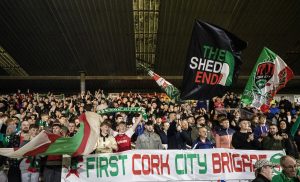
Following this trend Ultra Culture has become much more popular in recent years in the League of Ireland, once again most prominently amongst younger fans. Groups like the North Terrace Boys (Kerry FC), Blue Army (Treaty United), Commando84, First Cork City Brigade (both Cork City), Notorious Boo-Boys (Bohemians), and SRFC Ultras (Shamrock Rovers) are now well established.
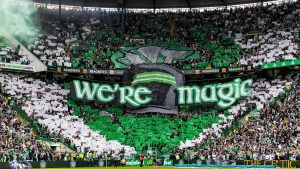
Several key elements make up the traditional Ultra culture. Less problematic practises include the use of drums and megaphones alongside highly co-ordinated chants. Stickers identifying the Ultra group are also very common, the idea being to place these stickers in the opposing teams’ grounds and surrounding area during away day trips. Tifos are also central, consisting of an elaborate, coordinated visual display created by Ultra group which normally cover large sections of a stadium alongside banners and other flags. The term originates from the Italian word tifosi, meaning “those infected by typhus,” referring to the fans’ feverish passion. These displays are meant to motivate players, intimidate opponents, and celebrate club identity.
The use of tifos can have both positive and negative aspects. One recurring problem is their use to make political statements. In Feb 2025 the Celtic Ultra group The Green Brigade unfurled a huge tribute to Brendan ‘Bik’ McFarlane. McFarlane was a member of the Provisional IRA who was sentenced to life imprisonment after the Bayardo Bar attack in 1975 where five civilians were killed including 2 women. In 1982 it is alleged he was involved in the Don Tidey kidnapping which resulted in the murder of a Garda and a member of the Irish Defence Forces. The controversial Ultra group held up a tifo which contained an image of McFarlane including a banner which read: “They said he was a rebel then. He’s a hero now.”
Across the city, the Union Bears, Rangers Ultra group, unfurled a banner in March 2025 stating “Keep woke foreign ideologies out. Defend Europe.” Rangers were subsequently fined 25,000 pounds approx. by UEFA. Celtic were not sanctioned for their banner but the Green Brigade have since come into conflict with the club authorities. Members of the Green Brigade had their season tickets suspended and the area of the ground where they usually stand has been closed following accusations of violent behaviour and threats to staff at Celtic Park. The club stated the suspension had nothing to do with banners that had been displayed.
In March 2025 the Blue Army held up a banner stating ‘McCormack Out: Team Not Regime‘. The banner referenced Ciara McCormack, who was chief executive and co-owner of Treaty United at the time. McCormack alleged that this was tantamount to “bullying” and claimed she was “verbally assaulted” by a large group of “people”. In Nov 2025 McCormack stepped down as Treaty CEO.
Tifos can also be used do deliver a positive message. When Paris St. Germain won the Champions League in 2025 the club’s Ultras unveiled a banner displaying their manager Luis Enrique with his daughter Xana, who died when she was just nine years old in 2019. In 2024 the Shedside Army of Dundalk FC unveiled a banner remembering hardcore fan Mark Kavanagh, also known as “Maxi” McAllister, upon his death.
The display read ‘Maxi, Dundalk Loves You More Than You Will Know”. Maxi famously had entered the FAI offices in 2006 and poured petrol on the carpet, furniture and Christmas decorations. The father-of-one then poured some of it over himself before taking out a cigarette lighter and threatening to light it. The lighter did not have a flint in it. Kavanagh was a life-long passionate Dundalk supporter who had become “consumed” with the FAI’s decision not to allow his club “take its place in the Premier league”. He was sentenced to four months’ imprisonment.
As recent events in Louth show it is the use of pyrotechnics that are the most controversial aspect of Ultra culture in the Irish context. It cannot be denied that pyros, both flares and smoke bombs, can greatly add to atmosphere within League of Ireland stadiums. In the past the FAI have instituted fines, away day bans and partial stadium closures for the use of pyrotechnics, usually for flares thrown on the pitch or striking players or officials.
The threat of points deductions has been raised. Often stewards are forced to eject young fans from games which in turn can lead to lengthy bans. The use of pyros has been escalating over recent seasons showing how the campaign to eradicate their use has failed with flares and smoke bombs in clearly evidence across the opening weeks of the League of Ireland 2026 season.
The question remains can pyros be used in a safe manner. To date Norway is the only UEFA affiliate to accept that they cannot change fan culture and have allowed it, with rules to ensure safety. The methods used are different with each club. At Valerenga, a Norwegian professional football club from Oslo, flyers are given out before a game telling supporters that there will be pyro. If supporters don’t like the smoke, they are asked to contact the SLO (supporter liaison officer) or staff so that it can rearrange to move the spectator to a different part of the stadium. Often pyro displays are restricted to before kick off and there is official liaison between the Ultras and fire safety authorities. However both flares and smoke bombs are illegal in Ireland which makes the prospect of a ‘safe use’ policy incredibly problematic.
The experience of attending live football is a key component for young fans post the Covid pandemic when so much of their lives are lived in the digital world. With ubiquitous coverage of high quality football on TV, a key selling point of the League of Ireland is the live nature of its product. The old days of passively watching football is no longer attractive to younger fans. What remains in conflict is two different approaches to supporting football, the half and half scarfs and Premier League grounds with next to no atmosphere versus the Ultra model with all its noise and theatre. In the League of Ireland it cannot be denied that Ultra culture is moving hand in hand with the growth of the league.
Clubs can also be proactive. At Cobh Ramblers the club paid for a drum and megaphone for the use of the burgeoning Ultra group. A tifo display for the game against Dundalk was also facilitated by the club.
The Minister for Sport, Patrick O’Donovan, suspending all further funding for astroturf pitches in the League of Ireland, after the incidents at the Louth derby, indicates how serious this issue has become. While many see this threat as an overreaction which punishes all fans and all clubs, those both guilty and innocent, there can be little doubt that this particular nettle must be grasped firmly by league authorities.
In short a workable solution must be found. I would humbly suggest engagement with the various Ultra groups is the best possible solution, seeking alternatives to pyro use to deliver colour and pageantry to our league as it continues growing from strength to strength. The use of drums and megaphones, tifos and flags can all be accommodated and encouraged. The league must be open to adapting the fan experience to suit its new audience. Failure to do so could quickly lead to the gains that have been achieved evaporating as younger fans lose interest in the wake of over enthusiastic stewarding. The clock cannot be turned back. The old approaches are no longer fit for purpose.
Piece Written by Kenneth Hickey
Kenneth Hickey is a Cobh Ramblers Season Ticket Holder
You can Find Ken on all his socials below!
X: @Kenny_K75
Instagram: @rams_1922
Tiktok: Rams 1922