




Why are Galway United conceding more in 2026? A deep dive into stats, tactics, and personnel behind their defensive issues this season.
As a Galway fan, the opening two years of the Tribesmen being back to Ireland’s top flight has been defined by one characteristic, defensive solidity, especially in Eamon Deacy Park. In 2026 however, John Caulfield’s outfit has lost this trait, conceding 17 goals across 12 games so far this season, with only one clean sheet. Caulfield teams have always kept a solid defensive record through the years, so what has changed?
The Numbers Behind the Decline
Firstly, it’s fitting to look at the stats for Galway United in the past years. So far this season Galway have conceded 1.42 goals per game on average (17 goals in 12 games), and have only kept one single clean sheet, which came against Sligo Rovers in a 1-0 victory at home. Galway rank 8th in the league this season for xG faced (16.1 total, 1.34 per game, 7th in league) and goalkeeper Evan Watts has faced 63 shots on target, (6.08 a game), with 14 shots on target coming in their game against Dundalk. Watts has averaged 3.75 saves per game so far this season with 45 saves, and has a save percentage of 73%. Galway have averaged around 50% of their duels in the ground and the air. This season, Galway have a -2-goal difference as I’m writing this, scoring 15 goals and conceding 17.
Things get interesting when you compare these stats from 2026, to the seasons where Galway were more defensively sound in the 2024 and 2025 seasons. Goals per game, 2024, (0.8 per game, 29 total, 2nd in league), 2025 (1.2 per game, 44 total, 7th in league). Clean sheets, 2024, (16 total, Tied 1st in league), 2025, (5 total, 8th in league). xG faced, 2024 (38.16 total, 1.06 per game, 5th in league), 2025 (46.6 total, 1.55 per game, 5th in league). As you can see from these stats, Galway’s defence has grown weaker in recent years. Galway were especially known for their rock-solid fortress in Eamon Deacy Park. Through the years Galway saw the following in goals allowed at home: 2026, (7 total, 1.4 per game), 2025, (22 total, 1.22 total), and 2024 (12 total, 0.66 per game). In the span of two years Galway have seen a 133% increase in goals against at home. The graph below illustrates these statistics clearer.
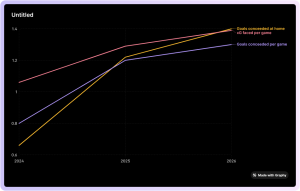
But what has caused these stats is the question, the aim of this article is to determine the cause for this significant change. I have widdled it down to a few key aspects which I will further discuss. It is also worth noting that Galway are only 11 games into their season, and this data can still change, but is worrying for the Maroon and White a third of the way into the season. I should also mention that the 2025 season saw 29 more goals scored in the league, 2024 (408), 2025 (437). This season is expected to see a further rise in goals, as after 63 games of the Premier Division in 2026, we have had 166 goals scored, and are on track to see 474 goals this season if the current trend continues.
Squad Turnover and Defensive Instability
Firstly, and most obviously, there has been a lot of defensive turnover for the Westerners since the 2024 season. Bar Patrick Hickey, who played up front or in the middle of the park during his time in Galway, John Caulfield had 11 defenders to choose from in 2024, which was reduced to 9 in the 2025 season, and now stands at 7 defenders, (excluding Billy Regan in all seasons, as he has not played in any games). The period between 2025 and 2026 saw Galway only retain one defender, that being Killian Brouder, who joined the club in the summer of 2019. Last winter saw former captain Greg Cunningham, Garry Buckley, Rob Slevin, Regan Donelan, Bobby Burns, Jeanot Esua, and Colm Horgan depart the club, and loanee Cian Byrne leave the club in the summer. The large-scale departure soon saw Wasiri Williams, Gianfranco Facchineri, Arthur Parker, Conor Barratt, James Morahan and Al-Amin Kazeem join the Tribesmen. Naturally, replacing an entire defence would uproot a team’s defensive structure and it is safe to say it has done here.
To delve deeper into the personnel available to John Caulfield this season, I first want to look at the full backs. We will start on the left, with Lee Devitt. Devitt has been one of Galway’s new signings this year, coming off of a terrific season with Treaty United. Last season for Treaty, Devitt played across the midfield, upfront and off the left wing, and didn’t appear as a full back. This is an obvious reasoning, as Devitt is a more attacking player, scoring 16 goals last season, including 2 hat-tricks. Moving on to the right flank, which Swansea loanee Arthur Parker currently occupies. The 19-year-old has been accustomed to playing across the backline, and appeared as a substitute for Swansea in the EFL Cup. Now in no way am I putting blame on these players, but the combination of inexperience and being out of positioning is unusual for a John Caulfield side. To put this into comparison to previous full backs for Galway, we can look at the likes of Greg Cunningham, Jeanot Esua, and Bobby Burns. A common trend among these three, is that they were all experienced full backs and knowing signature Caulfield sides, they are known to be rigid at the back and have always had a seasoned group of defenders.
Tactical Changes and Inexperience at the Back
Looking at the other defenders you have Facchineri, (22 years old), Connor Barratt, (22 years old), Wasiri Williams, (26 years old), Al-Amin Kazeem (24 years old) and Killian Brouder (27 years old). Overall, the average age of the defence including James Morahan and Billy Regan who are yet to appear is 22.33 years old. This is in stark contrast to 2024 (25.3) and 2025 (26). This lack of experience is a reason to believe in the defensive issues so far this season. With only one experienced defender out of the back four in Brouder, it’s a clear matter of inexperience on the pitch and as a team. Also, interestingly for Galway this year, it has strictly been a four-back shape for Galway. This structure has changed over the past years from operating between a five back and a four back. The defensive structure in the midfield has also undergone change from 2024’s double pivot to the single pivot of today. These change in formation has succeeded in scoring more goals, but it is noticeably contributed towards the defensive structure of the Tribesmen. Galway have scored 15 goals so far this season, averaging 1.25 goals per game, in comparison to 1 per game in 2025 and 0,9 in 2024. Maybe John Caulfield has had an epiphany in the last two years and has decided to take a more attacking output, but considering his various titles with Cork City and league cup double win in 2017 with the Rebels, why change something that isn’t broken.
Set Pieces: Galway’s Biggest Weakness
I also took the time to analyse the 17 goals that Galway have allowed and when you break it down it gives a great insight as to the weakness of this defence. Galway have let in 9 goals from open play, with the remaining 8 from set pieces. Galway have conceded 2 penalties, 5 from corners and one from a long throw in. Further analysing these goals, eight of them have come from while the ball was in the air or bouncing. Padraic Amond’s goal against Galway in Eamon Deacy Park, came from Brouder not reading a bounce and allowing Amond an easy chance on goal. Galway’s penalty against Shelbourne came from a bouncing ball in the box, and Williams kicking the man instead of the ball, and along with being unable to deal with 4 corners it is a certain point that set pieces have been a weak spot for Galway. All 3 of Drogheda’s goals against Galway this season have come from 2 corners and a throw in, and Waterford’s 96th minute equaliser last week was scored from a corner. It can clearly be said that set pieces have been an issue as Galway have faced 4.12 xG this season against set pieces after 12 games, which contrasts to 6.8 total xG faced per year across 36 games in the 2024 and 2025 seasons.
With me being pedantic, I further disected a couple of goals that have struck the back of Galway’s net, and they highlight the issues Galway are seeing from set pieces. Looking deeply into the first of the two corners Galway let in against Drogheda which can be seen alone, we can see 7 Galway defenders against 4 Drogheda attackers, should be an easy clearance. Looking at the back post in particular, 5’7 Ed McCarthy was assigned to 6 foot Mark Doyle. With a severe height and strength difference that Doyle dominates, he is in for an easy finish at the back post. What is over seen however is the 2 spare men at the front post for Galway, with one being 6’1 Frantz Perriot. It would have made a considerable amount of sense to assign Perriot to Doyle, and letting McCarthy prepare for a counter attack, still giving Galway extra men at the front post.

These next goals below show two free headers for Drogheda and Bohemians. It is simple to see that the Galway defenders this year don’t pose the same aerial capabilities as defenders from previous years.
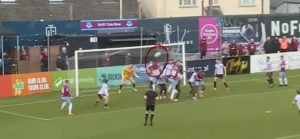

If we look at the play before the cross comes in to Patrick Hickey for Bohemians, you can see he is being marked by Wasiri Williams at the front post. Hickey then moves into space and is not tracked by Williams and here he gets an open header and scores the winner for Bohs. Simple errors like these have proven so costly for Galway this season and it proves to be a re-occurring theme for the Tribesmen in 2026.

As we come into Galway’s 13th game of the season against table toppers St Pats, who have scored 7 goals from set pieces this year (creating 6.9 set piece xG this season), and who are the highest scoring side this year (24 goals, 1.8 goals per game), it will be interesting to see how John Caulfield’s outfit will set up defensively against the high flyers from Richmond Park. It is also a certainty that Galway will be on the hunt for defensive options this summer, in hopes to push on further in the Premier Division.